Written for Edible Santa Barbara – Autumn 2025-Winter 2026
The Rituals of Dinner
Written for Edible Santa Barbara
Margaret Visser, The Rituals of Dinner
For millennia, humankind has ritualized gatherings around the table, be it to celebrate the end of the harvest season, the harvest moon, seasonal equinox, secular and religious holidays, or the advent of a new year. From Norwuz (celebrating the Persian New Year and the arrival of spring), Diwali (The Hindu festival of light), Dia de los Muertos (the day of the dead celebrated across Latin America) to the Japanese formal and seasonal kaiseki dinner or the Northern American celebration of Thanksgiving, each is notable for its particular dishes (for example, Sabzi Polo ba Mahi -the traditional Persian dish of aromatic herbed rice with crispy golden fish; Indian sweetmeats such as halwa, Ladoos and Gulab Jamun, richly sauced moles, Pan de Muerto and sugar skulls, artfully presented seasonal fish, rice and vegetables, and traditional roast turkey with stuffing) and unique rituals (deep cleaning of ones’ home, lighting lanterns, creating beautiful and colorful altars, expressing gratitude.) These rituals, and the foods prepared for each festivity, are passed down like a nourishing, continuously seeded ribbon of gustatory pleasures from generation to generation.
There is something comforting in the anticipation and repetition of these dishes. When I asked friends if they ever varied their holiday menus, some said, ‘absolutely not, everyone is looking forward to…’ and inserted the list of their favorites. For others, it is the act of gathering together that is important, with the meal playing a supporting role, albeit one that conforms in its structure to predetermined familial norms. We are, if anything, creatures of habit!
From medieval feasts around long tables with bread trenchers, to barn raising or harvest picnics, cattle drive barbecues or transhumance festivals, or traditional Sunday dinners, these gatherings all have one thing in common: they follow an almost symphonic structure, like a three or four-part play, orchestrated, like a savory and sweet melody.
Hosts simultaneously play the part of conductor and composer, arranging tables, guest lists, and planning the menu. The dishes served are an edible score, comprising a balance of textures, temperature, spices, aromas, piquancy, and delicacy, and multi-course dinners or multi-dish feasts such as Thanksgiving, allow for flourishes and indulgences beyond those served on a regular midweek meal.
My grandmother and mother both perfected the art of entertaining, producing four or five-course dinner parties with aplomb. As a young child, I longed to imitate them as these dinners were exciting and theatrical in their gastronomic drama, complete with plumed birds and dishes that were set alight, such as a crêpe suzette or Christmas pudding. Now, I realize that one doesn’t need flaming puddings for a dinner party to be a success, unless, of course, brandy-laced crêpes are your favorite dessert.
As children, we were first taught to set a simple table, then progressed, as we grew older, to more elaborate settings for family festivities and more formal occasions. At my grandparents’ home, this meant tables laid with starched linens, polished silverware, gleaming glasses, and cut flowers. I realized that my grandmother literally set the stage by creating an enchanting mise en scène for the meal to come. I have inherited not only some of her fine linens but also the ritualistic manner in which she set a table. I may have modified the menus served over time; gone for the most part are the heavy sauces my grandmother cooked, but I do delight in the creation of a beautiful tablescape for the meal to come.
Creating a dinner party menu is akin to writing the score, from a simple rhapsody: a buffet or table set with all the dishes out at once, to a more elaborate composition complete with an overture and a succession of movements—appetizers to whet the palette and tantalize tastebuds such as stuffed dates or savory crostini, followed by a seasonal soup or a delicate salad perhaps; a main course, the highlight of the meal where one might serve a whole roasted fish, a succulent stew, or a vegetable tagine, culminating with a grand finale, a dessert, a glazed tart, a cake or luscious mousse.
There is a cadence to the meal, with guests acting as part audience: observing, tasting, and savoring, and part orchestra: actively participating in the production of the dinner through conversations, interactions, and general bonhomie, conducted by the host in a mouthwatering culinary dance. The simplest rituals, from setting the table and lighting candles to more formal acknowledgements of gratitude for those who produced the food, those present, and those departed, all set the tone for the occasion.
Certain meals are inherently ritualistic, following long-prescribed formats with ceremonial foods and steeped in symbolic meaning, such as the Jewish Passover seder, the Muslim Iftar during Ramadan, Shabbat dinners, and Japanese tea ceremonies.
As I spoke with friends about their family’s dinner rituals, I realized that traditions that arise around the table are not all necessarily related to the evening meal, or a religious holy day. One family I spoke to decided to have their main family meal at breakfast as their complicated evening schedules, with four children in four different extracurricular activities, precluded their getting together then. Breakfast became a daily, fairly elaborate hearty feast, complete with its own traditions, favorite dishes and specific tasks for all present.
Other families, mine included, always gather in the kitchen before the dinner itself begins. There is camaraderie and a delicious anticipation that arises when surrounded by fragrant aromas. Cooks also want to be part of the action, not squirreled away behind closed doors. This gathering is such a common occurrence now that it has affected kitchen and dining room design, whereas each room used to be a designated, closed-off space; they are now often inclusive open-plan spaces, one leading seamlessly into the other, reflecting the less formal nature of mealtimes today.
Recently, as I was preparing the simplest of meals, a light dinner for one, I realized that whether making an elaborate feast for a special occasion with dozens of people, or just plating a small salad in a pretty bowl, the rituals and traditions that have anchored our daily lives are as much a part of the dinner as the food itself. Even in turbulent times, there is much to be said for the simple act of gathering together for the rituals of dinner.
Wild Mushroom and Taleggio Crostini
Many moons ago, I spent a summer baking cakes and tarts for some restaurants in the South of France. The fruits of my labor funded my first visit to the magical city of Venice. I spent days wandering through its labyrinthine streets, buying lunch from the floating vegetable markets on the canals — usually some grapes, a little cheese, and perhaps some grissini and prosciutto — discovering ancient churches and silent medieval squares. I was enchanted by every corner and walked for hours. The tradition amongst locals was (and is) to pop into a bacaro, a small wine bar, for a little pre-dinner aperitivo and some cicchetti, the small snacks coveted by the Venetians. There would be a wide assortment of small toasts with fish, cheese, or olives on top, and small plates of marinated vegetables, grilled peppers, and mushroom crostini, my favorite. Most of these places were standing-room-only and packed with locals who would pass little plates filled with local delicacies to one another, as convivial conversations swirled around the platters. That visit inspired the recipe for these crostini.
Serves 8 people as an appetizer
Butter
2 lbs assorted wild mushrooms — cleaned carefully and sliced
Salt
Pepper
1 tablespoon finely chopped chives
1 tablespoon finely chopped parsley
8 slices of ciabatta bread — lightly toasted
Lemon olive oil
2 oz goat cheese
6 oz taleggio or fontina — cut into small pieces
Endives and Pear Salad with Goat Cheese Vinaigrette
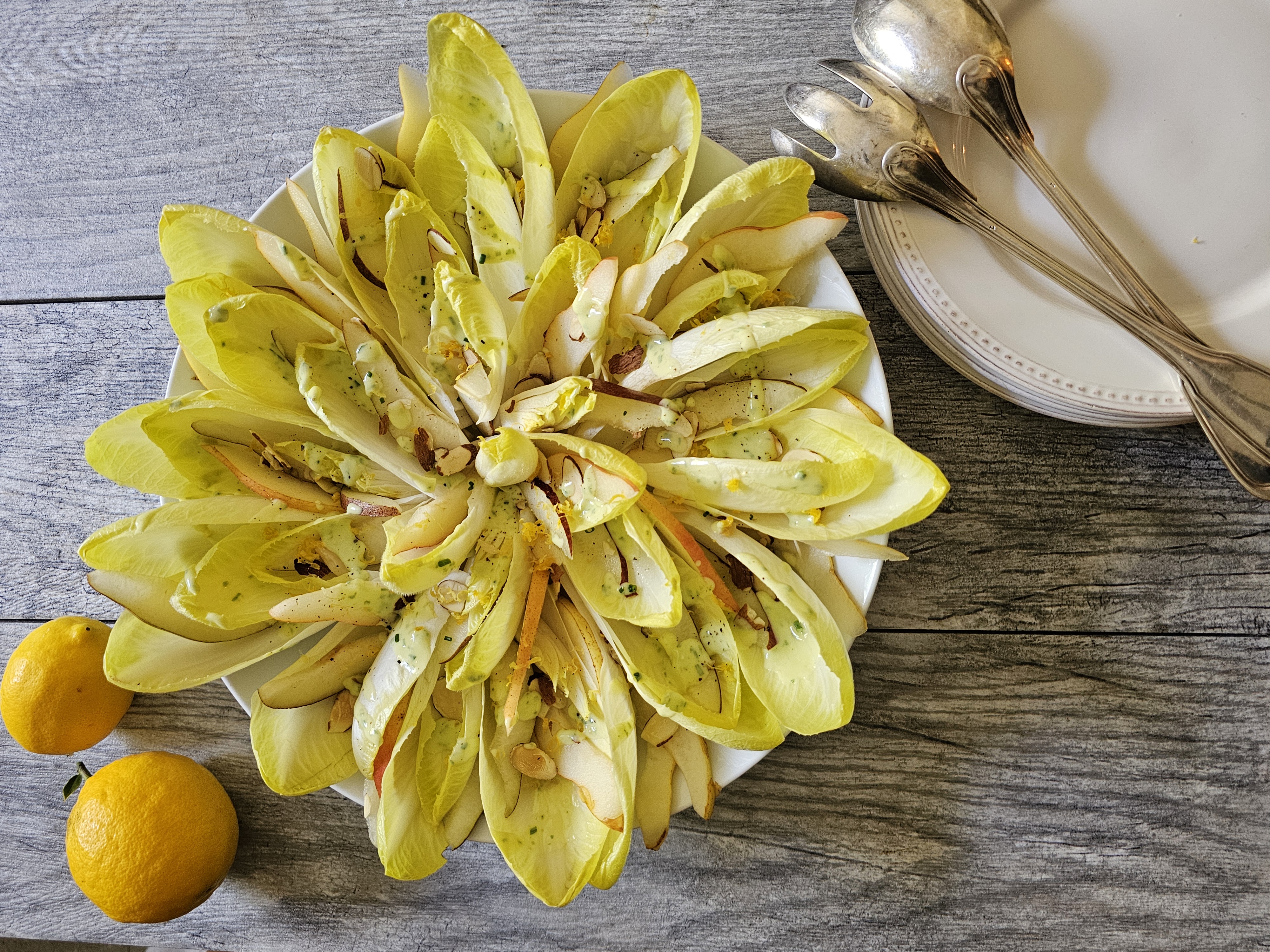 Belgian endives are my favorite of the chicory family. I love their versatility. They are transformed into a soft, buttery, unctuousness when braised or in a gratin, are the perfect vehicle for handheld appetizers, and are the foundation of so many salads, particularly those with blue cheese. In this dish, they are paired with pears, whose delicate sweetness complements the slightly bitter, crisp flavor and texture of the Endive leaves. The goat cheese in the vinaigrette provides a delicate yet tangy creaminess to the dish.
Serves 8 people
For the vinaigrette:
3 oz goat cheese
3 tablespoons finely chopped chives
1/3 cup extra virgin olive oil
¼ cup lemon juice
Zest of 2 lemons
For the salad:
6-8 Belgian Endives — leaves separated
4 pears — peeled, quartered, cored, and thinly sliced
¼ sliced almonds — toasted
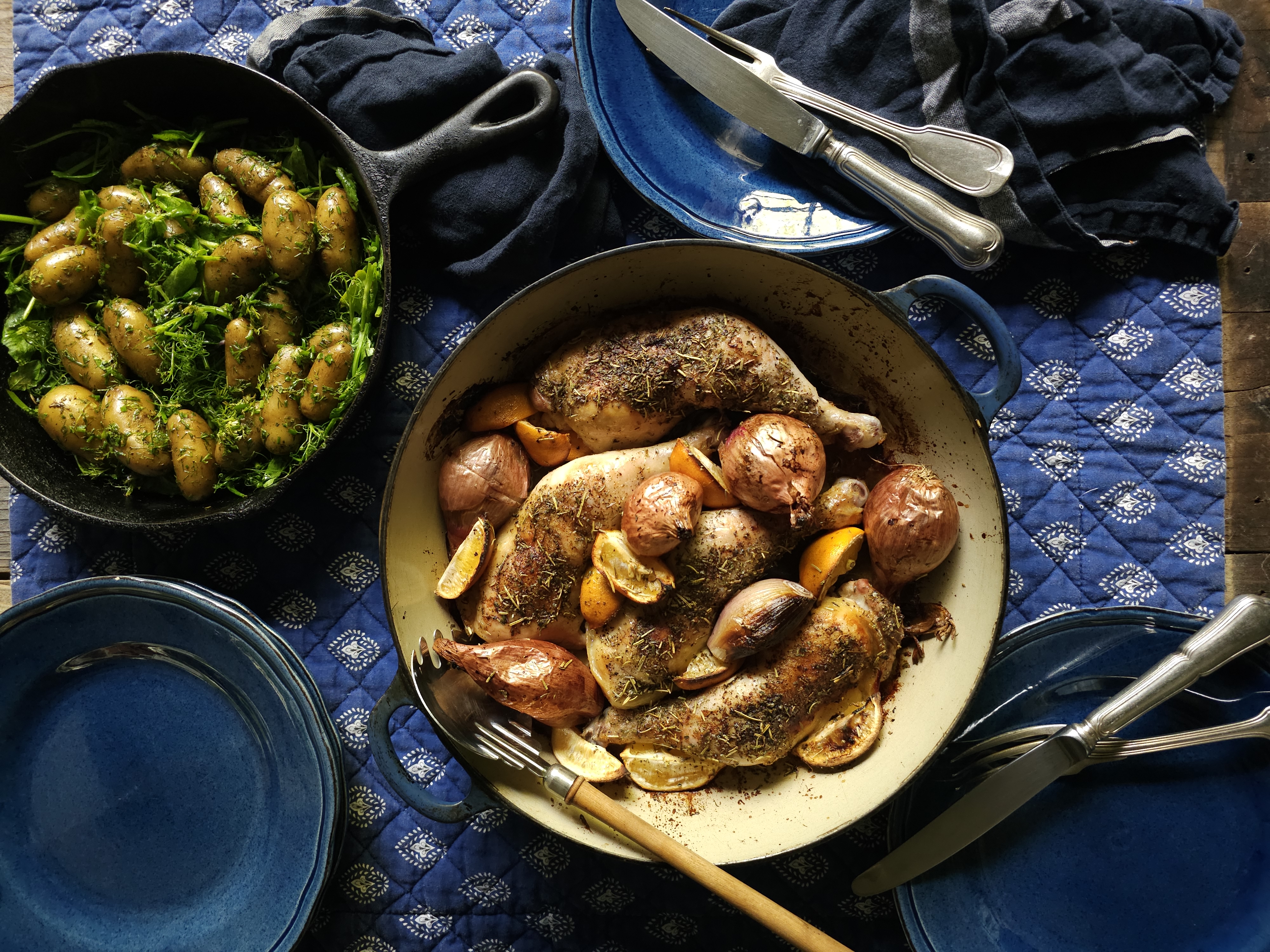
Lemon and Shallot Roast Chicken
This dish is a celebration in one pan, including little packages (whole baked shallots) to open and discover the delicacies inside. The lemon flesh can be eaten whole, even a little of the skin if you like. It will add a tangy punch to the dish.
Serves 8 people
8 whole chicken legs
6-8 lemons (Meyer if possible) — cut into sixths
16 shallots — any extra papery layers removed but essentially left unpeeled
Extra virgin olive oil
2 tablespoons Herbes de Provence
Coarse sea salt
Black pepper
Fingerling Potatoes and Wilted Greens
2 lbs. small fingerling potatoes
Extra virgin olive oil
Coarse sea salt
Black pepper
2 tablespoons finely chopped chives
2 tablespoons finely chopped chervil or parsley
1 lb spinach or pea sprouts
2 tablespoons crème fraîche
Spiced Apple and Pear Strudel
There is something magical about phyllo dough with its gossamer thinness and flaky layers that hide all sorts of treasures within. The dough is remarkably resilient as long as you work fairly quickly with it. I remember being apprehensive the first time I used this dough, but soon discovered that it was easier to work with than I thought. The key is having everything ready before you unroll the dough.
A variation on classic strudel, this has the addition of pears, with a textural, almost praline-like, crunchy nut topping that runs down the center of each piece. Be sure everyone gets some of the crunchy bits.
Serves 8-10 people
3-4 large apples — peeled, cored, and thinly sliced
3-4 large pears — peeled, cored, and thinly sliced
1 cup golden raisins
Juice and zest of 1 lemon
4 oz butter
1 tablespoon sugar
Pinch allspice
¼ teaspoon cinnamon
10 sheets phyllo dough — thawed
¼ cup each of hazelnuts, almonds, and pistachios — chopped
2 tablespoons brown sugar
1 tablespoon butter — melted
1 tablespoon powdered sugar
Crème fraîche or vanilla ice cream (optional)