


The thief came in the night. Thirty harrowing, heart-pounding minutes later, he was tied up, my parents bloodied, a police helicopter circled the house, and fifteen armed policemen surrounded us. I was forty-one weeks pregnant, adrenaline coursing through me, and very worried I'd go into labor. Hours later, parents home from being stitched up, our collective heart rates were just about back to normal as we gathered in the kitchen. It was a Sunday morning. We were supposed to have friends around for lunch. I said we should cancel, given what we had just gone through. My very English father said, 'absolutely not, we are not letting that @#*#*# ruin our plans.'
Renowned food writer M.F.K. Fisher wrote in her WWII memoir ‘How To Cook A Wolf’, “I believe that one of the most dignified ways we are capable of, to assert and then reassert our dignity in the face of poverty and war's fears and pains, is to nourish ourselves with all possible skill, delicacy, and ever-increasing enjoyment. And with our gastronomical growth will come, inevitably, knowledge and perception of a hundred other things, but mainly of ourselves. Then Fate, even tangled as it is with cold wars as well as hot, cannot harm us.”
I could hear the echo of Fisher’s words in my father’s. He understood, indeed thought it essential, that gathering, cooking, and feeding people were how we would overcome and digest our collective shock. That Sunday lunch wasn't comforting. It was defiance. And so, having survived the ‘battle’, and very much in the spirit of Keep Calm and Carry On, we chopped, stirred and cooked, laid out silverware, brought out the finished dishes and took solace in the company of our friends gathered around the table. It was a balm for our frayed nerves.
My daughter, safely cocooned, waited to make her arrival. Eight days later, sensing the coast was clear, she was born.
I had lived and worked in big cities (London, Paris, Los Angeles), stimulated by the hustle and bustle, and thought I’d continue to do so, but something about that violent encounter lingered with me. The metamorphosis that is motherhood enveloped me. The more I thought about the future, the more I felt we needed to move. Serendipity provided the catalyst. Sometimes it’s as simple as someone saying, why don’t you get away for the weekend? It will do you some good.
A friend offered us her cottage in Santa Barbara for a few days while she was traveling. Would we like to go? She asked. We had been before, but only in passing, and decided that a few days of peace and quiet by the ocean were just what we needed. ‘Oh,’ she added as she described how to find her house, ‘there’s a market on Saturday mornings that you’ll like, Pascale; you should check it out.’ There are few words that I find more seductive, and we jumped at the chance to escape.
We woke up to one of those crystal-clear Central Coast mornings, the cloudless sky a deep azure, the ocean scintillating in the rising sunlight, the aroma of the local chaparral drifting in the gentle breeze. We drove slowly along the coast, watching the waves as they caressed the shore, listening to their soothingly hypnotic susurration as they ebbed and flowed. I could feel the stress ebb in my bones, too.
The Saturday market was, at that time, located in a tree-lined parking lot, with four rows of the farmers’ tables nestled snugly together. Their tables were resplendent, groaning under the weight of their summer harvest. I spied fat, juicy heirloom tomatoes, just-picked, slightly prickly zucchini, shiny, dark eggplant, and imagined the ratatouille I could make with them. There were fragrant bouquets of herbs, plump figs, sweet peaches, and glorious white nectarines. My taste buds were salivating. I itched to cook and filled our baskets. The sounds of the market filtered through the dappled sunlight: farmers extolling their produce, friends greeting friends, an accordionist playing, of all things, La Vie en Rose. Children clutched dark red strawberries, the juice squeezing through their fingers, sticky smiles on their faces.
The place was bucolic. I imagined walking through these aisles every weekend; the rhythm and pace of the market tugged at a visceral thread that connected this Pacific coast town to the Provençal towns of my childhood. There was synergy between them, their red-tiled roofs, white stucco walls, the town tucked in between the ocean and the mountains, with vineyards and olive orchards inland. The familial echo of these landscapes pulled at my heart. What if, we thought, we left the big city for a slower pace of life? Wouldn’t this be a better place to raise our daughter? Eight weeks later, we decamped.
There is always a period of adjustment when one moves. Where’s the best place to get bread, the closest hardware store, a good plumber, a dentist, a babysitter, and so on? It is a tiresome process, but I’ve always found that if you unpack the kitchen first, a good meal can help, and we were keen to invite friends to our new home. My anchor in this upheaval was the weekly market. Anyone who knows me well knows my penchant for farmers markets and my tendency to linger there for hours. Maybe my infant daughter understood this as she gazed happily at the colorful displays and, as soon as she was able, had sticky pieces of fruit in her hands too. The weekly market led to weekend gatherings, and as the dust settled, I began to ponder what the future held for me.
I didn’t ponder for very long. A friend, over for dinner one night, asked if I had ever considered teaching people to cook. ‘I’m sure people would love to learn how to make this,’ she said, pointing to the dish on the table. She had unknowingly planted a seed, and just as the seasons were made evident in the slowly evolving array of produce at the market, the idea of teaching people took root.
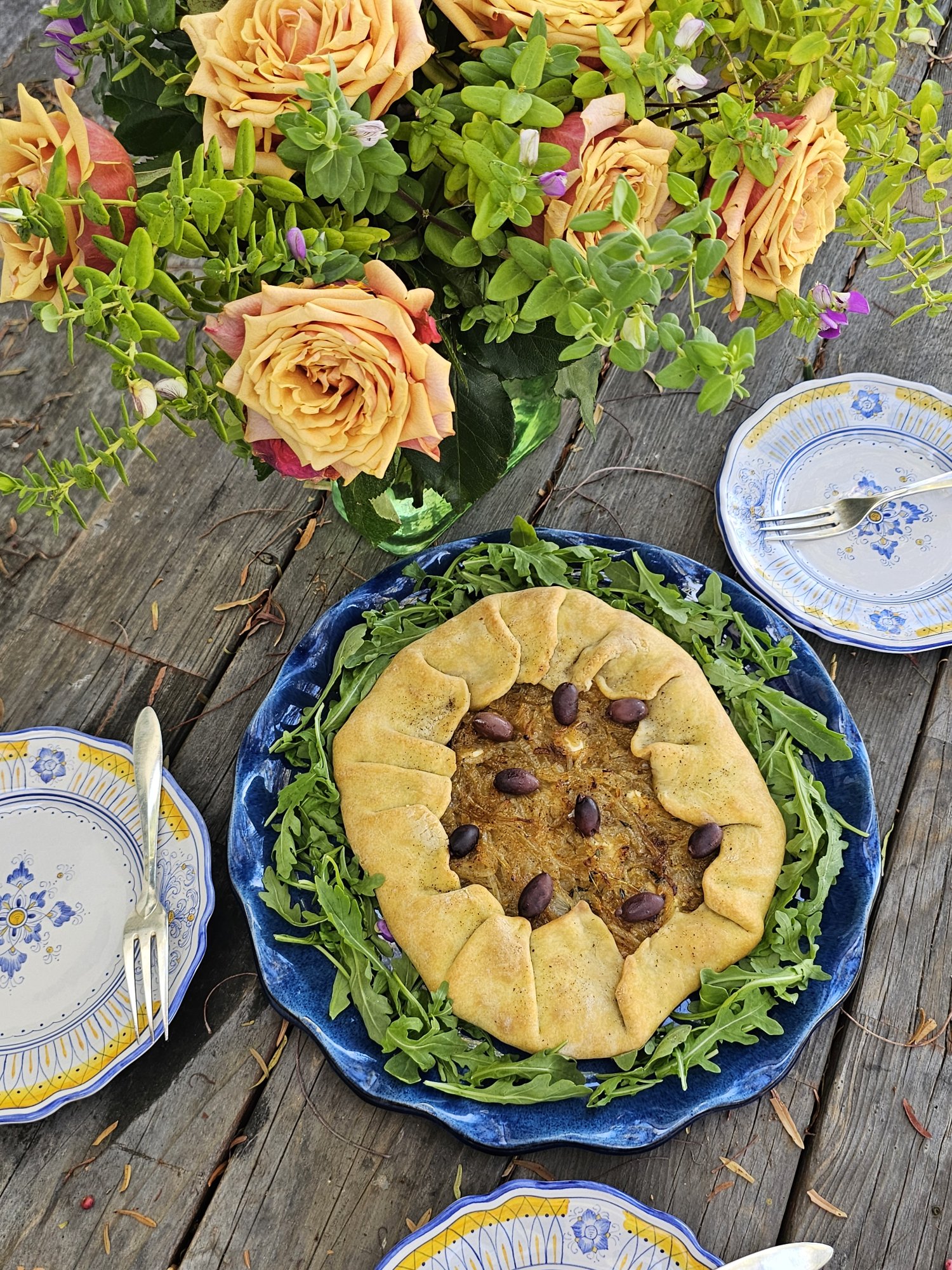
Twenty-seven years on, thousands of hours of teaching later, I look back at the hundreds of menus created over those 128 seasons and see a kaleidoscope of dishes and faces. I can still hear the laughter, the questions, the oohs and ahhs and sighs of pleasure. From the first dish I ever taught — a caramelized onion tart, straight from the kitchens of my native Provence — to one of the most recent, a watermelon gazpacho born of this American Riviera, I see how profoundly this land has nourished me, and in turn, the food I teach.
Laurie Colwin, food columnist and author, wrote: "The table is a meeting place, a gathering ground, the source of sustenance and nourishment, festivity, safety, and satisfaction. A person cooking is a person giving: even the simplest food is a gift." My father knew this. That thief unwittingly set the table for everything that followed. What felt like the worst night of our lives had, unknowingly, planted a seed. Stepping off the treadmill of city life into a quieter, gentler rhythm gave me the space to hear what I already knew. Not every dark night is the end of the story. Sometimes it's just the beginning.
Recipes for this article:
Caramelized Onion Galette
Lavender and Honey Roasted Cornish Hens
Pear Chutney
Poached Pears with Saffron
