


Spring Winds in a California Kitchen
Like the Mistral that unfurls itself across Provence, bowling down through the Rhone valley to the Mediterranean bringing with it chilly weather and even colder seas, or the Sirocco that billows up from the Saharan desert bringing heat and its signature red dust that will sometimes dust the snowy mountain tops in the alps in spring, we too have winds that shape our climate and whose effects can transform our landscapes. We have lived through the aftermath of fires sparked by Santa Anas or floods driven by atmospheric rivers. I thought about all these atmospheric phenomena as I was re-reading a collection of essays by Elizabeth David entitled ‘South Wind Through a Kitchen.’
David, a British food writer, whose transformative work, The Book of Mediterranean Food, literally brought a ray of sunshine to still-rationed Brits when it was released in post-war Britain in 1950. The book spoke of dishes rich in olive oil, scented with garlic, and plump olives. “Provence is a country to which I am always returning, next week, next year, any day now, as soon as I can get onto a train. Here in London, it is an effort of will to believe in the existence of such a place at all. But now and again the vision of golden tiles on a round southern roof, or of some warm stony herb-scented hillside will rise out of my kitchen pots with the smell of a piece of orange peel scenting a beef stew…”
She allowed Britons to imagine a better time, a richer palette, and more succulent, albeit simple meals. What I realized reading her books is that in the face of perilous situations, what we had and still have in common is the collective resilience of the local populace. David could be describing the central coast, and, faced with whatever hardships nature and the environment have thrown our way, our community comes together. What better way to show our sense of community than through food?
David is not alone in championing the benefits of a hearty meal or the collective power of gathering people around a table. From Cesar Chavez, who once said, If you really want to make a friend, go to someone's house and eat with him… The people who give you their food give you their heart, to Jose Andres, whose World Central Kitchen advocates, ‘A meal is never just a plate of food. It has the power to change the world, to bring people together, to tell the story of who we are and where we’re going.’ The key ingredient is that the food in question doesn’t have to be elaborate or require expensive produce. The key is in the sharing of that food, and it is easiest when it is abundant. This is when seasonal eating comes to the fore.
Stroll through any one of the nine, county-wide farmer’s markets, and you will have your pick of sensational seasonal produce. Tables of beautifully arranged fruit and vegetables beckon passers-by and feed one’s imagination. Who can resist ruby red cherries or golden apricots when they appear for their all too short season? This is the time when I rush to make apricot jam, trying to capture its essence with enough jars to last through the year, and share with friends and family. But what happens when there is a profusion of those fruit or vegetables? What if not all the produce is sold? Or if less-than-perfect produce is not harvested? In the past, the excess would often end up in a landfill or plowed under, but for the past twenty years, a remarkable group of local community-led organizations has gleaned that excess and distributed it to those in need. Backyard Bounty, Veggie Rescue, Food From the Heart, The Bucket Brigade Humanitarian Farm, and many local Community Gardens are among the county-wide entities that harvest locally grown produce and have collectively distributed millions of pounds of food since their inception. In a country where nearly 40% of the food supply goes to waste and a county where, sadly, close to 20% of the population lives below the poverty line (now the second-highest in California), these community-led endeavors are a nourishing lifeline to those in need. We are fortunate to be surrounded by an extraordinary farming community (there are just under 1500 small farms in the county), many of whom partner with these organizations and donate their produce.
There is a long history of communal food sharing. From the Victory Gardens that sustained the country during the two World Wars, to the profusion of pop-ups that fed us during the Pandemic to meal trains that nourish us when a family is in crisis, each time, the community rallies. If one is fortunate enough to have access to fruit trees or has planted tomatoes, thinking of all the delicious things you will make with them, then, months later, when all the fruit ripens at once, you wonder what on earth you are going to do with all that bounty. The answer, unless you are a prolific jam maker or canner, is to share it if you can. I have a friend who annually puts out a call to her nearest and dearest to come and pick what they want from her overproducing plum and peach trees, as her family cannot eat it all, and another who regularly leaves heavenly boxes of citrus on my doorstep from her prolific trees. These are unexpected and much-appreciated gifts from the land, and I happily exchange fruit for jam. As acclaimed chef Eric Ripert once wrote: 'Cooking is a holistic process of planning, preparing, dining, and sharing food. I place food at the center of our humanity, as it nourishes not only our physical bodies but also our emotional and spiritual lives. Food is truly a cultural phenomenon that informs our traditions and our relationship with the earth. I genuinely believe that food connects us all.' I couldn’t agree more.
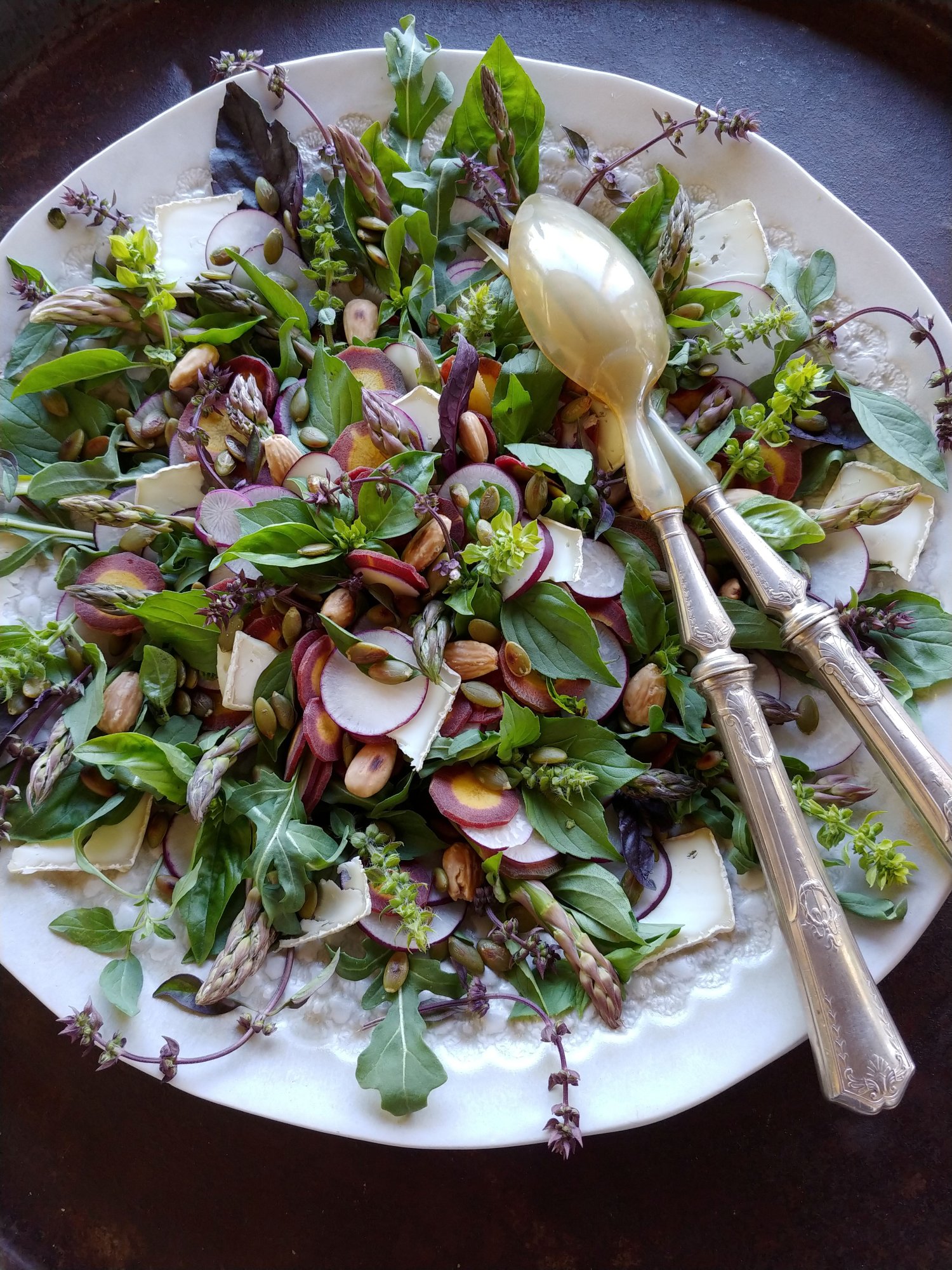
Arugula, Asparagus and Basil Salad
This salad has raw asparagus in it, that’s not a type-o. They’re delicious, crunchy, earthy and herbaceous at the same time. If you don’t fancy completely raw stalks, just pop them into a shallow pan of boiling water for just a couple of minutes to barely cook them. Either way you will have a lovely refreshing spring salad.
Serves 4 people
For the salad:
4 ounces (113 grams) baby arugula
2-3 radishes — very thinly sliced
2 medium sized carrots — peeled, then very thinly sliced
2/3 cup (15 grams) packed basil leaves
¼ cup (36 grams) toasted almonds
8 ounces (227 grams) raw asparagus stalks — woody ends trimmed away
2 ounces (65 grams) sliced goat cheese
For the vinaigrette:
1 tablespoon mustard
¼ cup (60 ml) olive oil
1 tablespoon white wine vinegar or white balsamic vinegar
Pinch of salt
4-5 grinds black pepper
1. Scatter the arugula, radishes, carrots, basil leaves and almonds over a medium to large serving platter or arrange them in a shallow bowl. Intersperse the asparagus stalks and sliced goat cheese into the assorted greens.
2. Combine the vinaigrette ingredients in a small bowl and whisk together to form a thick emulsion. When ready to serve drizzle over the salad and toss to combine.
Spiced Roasted Carrot Hummus
Ask any Middle Eastern chef or food writer about hummus, and they will rhapsodize about its near-magical qualities. Good hummus, they'll tell you, will draw people around the dinner table. It's a dish that celebrates conviviality and communion, and I adore food that gathers people together. Traditionally made with mashed chickpeas, tahini, olive oil, lemon juice, and garlic, this version has the addition of spiced roasted carrots, which gives the hummus a sweet, earthy fragrance. You can serve it simply with pita or with roasted vegetables to scoop up all that deliciousness. I encourage you to share this dish with all your friends.
Serves 8 as an appetizer or 4 as part of a main course
1 lb carrots — peeled and sliced into 1/2-inch pieces
4 shallots — peeled and chopped
4 tablespoons extra virgin olive oil, divided
1 ½ teaspoons ras al hanout
1 ½ cups cooked chickpeas — rinsed and drained if from a can
¼ cup tahini
2 tablespoons fresh lemon juice
¼ cup water plus more to thin if necessary
Fresh cilantro
1. Preheat the oven to 425°F.
2. In a medium bowl, toss the chopped carrots and shallots with 2 tablespoons of olive oil and the ras al hanout. Spread evenly on a baking sheet lined with parchment and roast until the carrots are tender and lightly browned, 18 to 20 minutes. Toss the carrots halfway through cooking.
3. In the bowl of a food processor, combine roasted carrots, roasted shallots, chickpeas, tahini, lemon juice, and water. With the motor running, drizzle in the remaining 2 tablespoons of olive oil, stopping the machine to scrape down the sides as necessary. If the hummus is too thick, add a little more water or oil. The finished hummus will still have a slightly chunky texture.
4. Spoon the hummus onto a serving plate, drizzle with extra olive oil, and scatter chopped cilantro over the top.
Za'atar Roasted Vegetables
1 ½ lbs carrots — assorted varieties, peeled and halved lengthwise if large
1 lb globe zucchinis — quartered or cut into sixths if large
Olive oil
1 teaspoon coarse sea salt
5-6 grinds of black pepper
½ tablespoon za'atar
1. Preheat the oven to 400 degrees.
2. Place the carrots and zucchini in a roasting pan or ovenproof dish. Drizzle olive oil over the vegetables, scatter the salt, pepper, and za'atar over them, and toss them to combine. Roast for 30 minutes. Serve with the hummus.
Shaved Asparagus, Broccolini and Farro Salad
I developed a taste for raw asparagus when my friend, Lynn, plucked a spear from its bed as we strolled through her abundant garden. “Try this,” she said. An explosion of flavor flooded my taste buds. I wanted to recreate that sensation and found that shaving asparagus results in a similar raw-grassy-herbal flavor. Add the shavings to any grain, such as the farro used in this dish, and you have the makings of a great salad. Farro, with its slightly chewy texture and nutty flavor, beautifully compliments the light, fresh asparagus.
Serves 4 people
3/4 cup farro — well rinsed
Olive oil
1/2 lb baby broccolini — sliced vertically
Salt
Pepper
Zest and juice of 1 lemon
1/2 lb asparagus (thick stalks) – shaved with a vegetable peeler into thin strips
1 small bunch watercress — tough stems trimmed
¼ cup almonds — finely chopped
2 oz Parmesan — shaved into thin slices
1. Bring a large saucepan of salted water to a boil. Add the farro and cook until al dente, and slightly chewy in texture, about 15-25 minutes. The best way to check for doneness is to taste! Drain the farro, fluff with a fork and let cool in a bowl or spread out on a rimmed sheet pan.
2. Pour a little olive oil into a medium skillet over medium heat. Add the broccolini, a pinch of salt and 4-5 grinds pepper, and cook for 2-3 minutes or until just softened.
3. In a large salad bowl, whisk together ¼-cup extra virgin olive oil, the lemon zest and juice, a good pinch of salt and 6-7 grinds fresh black pepper to form an emulsion. Place salad servers over the vinaigrette.
4. Add the cooked farro, broccolini, shaved asparagus, watercress and almonds to the bowl, placing everything on top of the utensils. When ready to serve, toss well to combine. Top with the shaved parmesan. Serve warm.
Note: A lovely, heartier variation of this salad is to add a poached egg onto each person’s salad. The egg is delicious when mixed in with the vegetables and farro.
Roasted Apricots and Cherries with Strawberry-Rhubarb Sorbet
This sorbet is an ode to a now-closed but much-cherished ice cream and sorbet shop we frequented for over forty years in Provence. The owner was a master sorbet maker whose blackcurrant and raspberry sorbets would make you go weak at the knees. His exacting standards are what I strive for each time I make a sorbet. He once told me that the key to capturing the very essence of the fruit is to use perfectly ripe fruit. It really does make a difference.
This deeply rose-colored and slightly tangy sorbet pairs sublimely as it melts gently over the warm roasted fruit. This dessert is a celebration of spring on a plate.
Serves 4 people
For the sorbet:
12 oz sliced rhubarb
4 oz sugar
Zest and juice of 1 lemon
½ cup water
12 oz ripe, cleaned and hulled strawberries
For the roasted fruit:
12 apricots
12 oz pitted cherries
2 tablespoons sugar
Zest and juice of 1 small lemon
1. To make the sorbet, Place the rhubarb, sugar, lemon zest, lemon juice, and water in a medium-sized saucepan. Bring to a boil, then reduce to a simmer and cook for 15 minutes, stirring frequently. Let cool. Purée the rhubarb in a food processor or blender for at least 1 minute until completely smooth. Add the strawberries and run the machine for at least 1 minute to achieve a fine-textured coulis. Refrigerate in a shallow bowl or container for 1 hour, then freeze for a minimum of 2 hours.
2. Preheat the oven to 400 degrees.
3. Place the apricots, cherries, sugar, lemon zest, and juice in a shallow ovenproof dish in which the fruit fits snugly. Roast for 10 minutes, then place under the broiler for 5 minutes.
4. Spoon the roasted fruit and pan juices onto small plates to serve. Place scoops of the sorbet on top of the fruit.
